On audiobooks

What makes a good read?
Earlier this week, I finished reading Patrick Radden Keefe’s London Falling: A Mysterious Death in a Gilded City and a Family’s Search for Truth. It was, like the rest of Keefe’s work, a very fine book, and if you’re looking for an excellent nonfiction read, it might be a good fit for you.
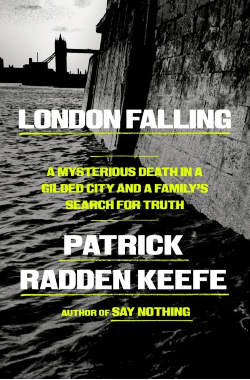
However, this post is not about reviewing a book’s content; rather, I’m more interested in the book’s form. You see, I did not actually read this book; rather, I spent about 13 hours listening to Keefe as he read the book to me. So do I get to say I “read” the book, or did I reduce it to a lengthy podcast? Or maybe it doesn’t matter. I wanted to learn from the contents of London Falling, and for a variety of reasons, listening to it was the better path.
Today, I wanted to expound a bit on audiobooks and what I look for in a text like this because, like anything else, these kinds of choices tend to be idiosyncratic, and I am curious as to how others approach this issue.
Back in the 2000s, Rob Stothart, an English colleague, and I began “The Northwest College Writer’s Series.” It was Rob’s idea and a low-budget affair. (The story of how we finally got a budget will have to wait for another day.) But we wanted to bring writers to our rural community college in northern Wyoming both to work with students and provide a bridge with the community.
We brought in serious writers, not all of them well known, but all of them willing to attend a class or two and work with students in addition to providing a public reading. (The details of The Series, too, are for another day.)
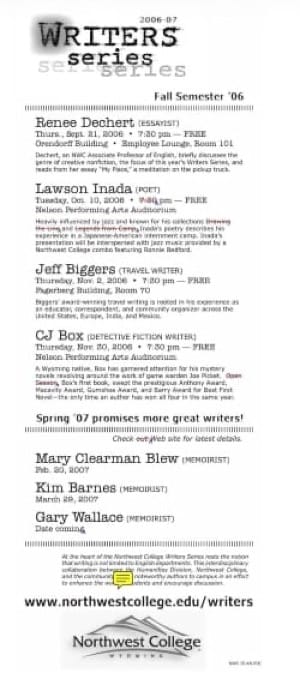
During that time, I came to appreciate writers reading their own work, pausing to explain what they were thinking when writing a particular passage, and watching them as they revisited something they had written and decided to share.
The Series lasted for, maybe, five years — Rob and I have trouble remembering — but it was something we remain proud of, and it was something from which we both learned a lot.
Like a lot of people, there was a time with the rise of social media, when I got away from reading.
Actually, it wasn’t that I had gotten away from reading — I was reading all the time, but now rather than taking on books, I was scrolling, gorging at an all-you-can-eat buffet of content. When I found what was then known as Twitter, I was hooked. So many experts shared their knowledge. Between my desire to learn more and a fast-growing FOMO, social media came to take the place of much of my book reading.
I would occasionally at the end of the year consider that I was reading fewer books than I probably should have been, but then the Twitter dopamine shot would hit as I found another interesting idea to consider, and I was off.
One day in the summer of 2021, I found that I missed listening to authors talking about their work, that kind of intimacy with ideas that Rob and I had experienced while coordinating The Writers Series.
I wanted to hear a writer tell me their story.
The Writers Series was long gone. Rob had retired, and the budget was cut, and I just didn’t have a lot of options. (After all, we’d built The Writers Series to get writers into our part of the world. When we stopped, no one stepped up to fill that vacuum.)
And then one day, while I was out on a walk yearning for a writer to talk to me, I downloaded an audiobook — Jeff Tweedy’s Let’s Go So We Can Get Back: A Memoir of Recording and Discording with Wilco, etc. — and I was hooked.
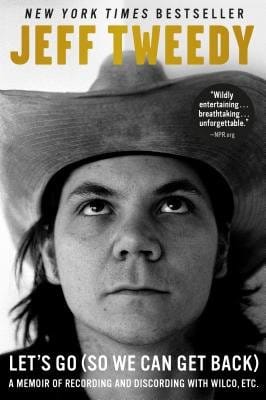
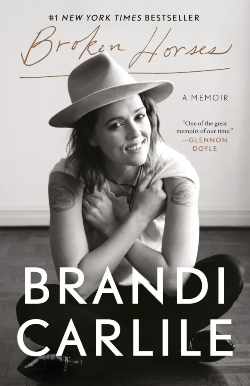
Tweedy’s memoir, which is well worth your time, was a writer telling his own story to the reader, the hard and embarrassing times as well as the triumphs. The qualities that make him a great musician also made him a great storyteller. I followed Tweedy with Brandy Carlile’s Broken Horses: A Memoir, which has lots of music and singing in addition to Carlile’s own compelling story.
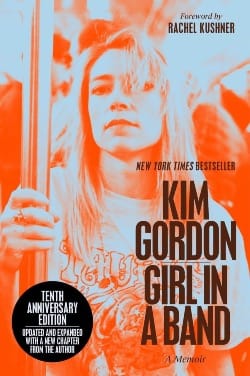
And I followed Carlile with Kim Gordon’s Girl in a Band: A Memoir. I never much cared for Sonic Youth’s music, but Gordon’s story and her voice drew me in.
I went on to listen to book written by authors who were not musicians, but in the beginning, they were my entry, in part because I was interested in their stories and in part because they did interesting audio things and insisted on reading their own work.
Even though audiobooks didn’t bring with them the intimacy of The Writer’s Series — I didn’t get to ask questions or notice how an audience responded to a reading or go out to dinner with the author — I quickly learned I had some criteria that determined whether I would listen to an audiobook.
Primarily, I needed the author to read the text for themself. I didn’t care if they weren’t a professional reader (though most musicians are very confident performing), but I wanted to hear the author sharing their own story. If someone hired a reader, I found I wasn’t interested.
First, I wanted that direct connection between me and the author. Second, too many audio narrators were focused on theater, on emoting, on calling attention to the drama of the moment rather than trusting the author’s words, and I wasn’t in for that.
I wanted something more intimate.
So, Chrissy Hynde, I’d love to read Reckless: My Life as a Pretender, but I’m not willing to listen to someone who’s not you tell your story.
I also learned that an eight-hour audiobook is a pretty good read — long enough to tell a good story, but not too much of a commitment. Anything over 10 hours is asking a lot. (As a side note, women tend to write shorter memoirs than men do, yet another topic for another day.)
Some books, I still want in print (e.g., Patti Smith’s Bread of Angels: A Memoir though I listened to the audiobook, too, because she’s Patti Smith), and some, I like on an e-reader so that I can take it wherever I want to go and spend some time mulling passages that interest me (e.g., David M. Perry’s The Public Scholar: A Practical Handbook) so that I may return to it.
And when it comes to fiction, I’ll go with a narrator who’s focused on the story, like Jesse Buckley, who narrates Maggie O’Farrell’s Hamnet: A Novel of the Plague. (Then again, it makes sense she would be the perfect narrator.)
Then there are writers who like to explore the audiobook as a form, like George Saunders’ Lincoln in the Bardo (with a cast of readers) or anything by Brené Brown, who clearly understands that an audiobook is a different form, so she adds asides exclusive to the audiobook to make those readers feel like they’re getting something extra.
Right now, I’m reading Keefe’s Empire of Pain: The Secret History of the Sackler Dynasty. It’s not a subject I thought I would be especially interested in, but after finishing London Falling, I knew I wanted to continue to hear his storytelling. And, it turns out, Keefe (again) tells a very good story — and he narrates his own books.
So that’s my approach to audiobooks, which let me read while I’m doing housework or taking a walk or just wanting to take my mind off things. And I’d be curious to hear yours.
As always, thanks for reading —
Renee
ReneeDechert.ink is an old-school blog in which the author explores a range of subjects and archives some of her earlier work.
Expect posts to appear whenever they appear.
Contact me at Renee.Dechert@gmail.com.